


Technical review seriesThis article forms part of a three-part technical review series on canine longevity, beginning with nutrition, body condition and digestive health, before moving into ageing biology and its practical application.

Ignasi (Nacho) Navarro-Regnè. Veterinarian, PMD from IESE and Master’s in AI, specialized in canine longevity and nutrition, with extensive business development experience in APAC.
For years, we have accepted canine life expectancy as though it were an almost fixed number. Yet evidence suggests that nutrition, body condition and digestive health are part of the biological trajectory of ageing and, therefore, part of the longevity conversation too.
A question we can no longer avoid
In little more than a century, human life expectancy has doubled [2]. Not because of a miracle intervention, but because we have learned to intervene earlier, better and more intelligently across the course of health. That is why it is difficult to understand why, when we speak about dogs, we still accept longevity limits that are often presented as barely modifiable. Today, that reading is too narrow. We know far more than we did thirty years ago about nutrient density, digestibility, metabolic control, low-grade inflammation and digestive health to go on talking about canine longevity only in terms of breed, size and inherited averages [1].
It is still said that most dogs will live somewhere between ten and fourteen years, but a table describes a population, not how an individual ages, nor the role of feeding, weight, digestive health, microbiota, prevention or owner adherence over time.
The problem is not the tables, but how we interpret them
Canine life expectancy tables are not useless [1]. They remain useful for describing population trends, comparing groups and putting expectations into context. The problem appears when they become a mental ceiling. Because a table does not explain biological processes. It tells us how long certain dogs lived under certain conditions. It does not tell us precisely how much of that trajectory was shaped by human decisions repeated thousands of times, nor how much real room there is to modulate ageing from far earlier stages than we usually assume [1].
And this matters because, in veterinary medicine and across the companion animal industry, we are still carrying an overly reactive model. Action is taken when the dog has already gained too much weight, when digestive dysfunction has already become chronic, or when functional decline is already visible. But longevity does not begin when a dog enters the senior category. It begins much earlier, in everyday biology.
Lifespan and healthspan are not opposing paths
At this point, it is worth making a distinction that is increasingly relevant in veterinary medicine too. Lifespan is not the same as healthspan. The first refers to total duration of life. The second refers to how long the dog lives with good function, good mobility, sound metabolic balance, healthy digestion and preserved cognitive capacity. A dog that lives longer, but spends a substantial part of those years in pain, obesity, digestive fragility or cognitive decline, does not represent a complete success.
What matters is that both concepts converge on the same biological systems. And that convergence is not theoretical, because behind it sit very concrete processes, such as chronic low-grade inflammation, oxidative stress, metabolic dysregulation and the progressive loss of physiological resilience. Geroscience has been showing for years that ageing is not simply a matter of accumulating time, but of moving through interconnected processes [3]. That means the conversation about longevity can no longer be separated from the conversation about nutrition and digestive health.
Everyday life is biology too
This is where nutrition stops being a basic variable and becomes a first-order biological tool. Diet quality, nutrient density, digestibility, energy balance and the ability to sustain an appropriate body condition are part of the ageing trajectory. The study by Kealy and colleagues, published in 2002, remains a key reference in canine longevity because it showed that maintaining an ideal body condition was not an aesthetic goal, but a clinical intervention with a real effect on life expectancy and delayed onset of age-related disease [4].
For me, there is an important lesson here that we still have not fully absorbed. Body condition is not a superficial consequence of lifestyle. It is a functional biomarker of the kind of ageing we are building. And if that is true, then the conversation about nutrition becomes far more serious: what metabolic, inflammatory and digestive signals we are sending to the dog’s organism every single day, and to what extent the diet is capable of supporting metabolic homeostasis over time.
Digestive health, microbiota and the gut-brain axis
If I had to choose one axis that justifies why nutrition must enter the longevity conversation from the very beginning, it would undoubtedly be digestive health. Because the gut is not a peripheral actor. It is a critical interface between nutrition, immunity, inflammation, metabolism and even cognitive function [5][6].
It is increasingly difficult to speak about canine longevity without including concepts such as intestinal microbiota, dysbiosis, microbial metabolites, intestinal permeability or microbiota-inflammation balance. The microbiota participates in digestion, metabolite production and the regulation of inflammatory processes that form part of biological ageing. And once the gut-brain axis is brought into the conversation, digestive health also becomes part of behavioural resilience, cognitive function and the dog’s adaptive capacity across life [5][6].
And there is another point that matters a great deal. The microbiota changes with diet, age and environment. In other words, it takes us back to the same conclusion: a dog’s ageing cannot continue to be treated as something that simply “arrives”. It is being built [5][6].
Beyond genetics, there is a modifiable margin
When population studies [1], longitudinal body condition data and the literature on microbiota and functional ageing are read together [5][6], it becomes difficult to defend a purely deterministic interpretation. Genetics matter, of course. Size matters. Predisposition matters. But they do not explain everything.
Within that modifiable margin sit not only body condition and diet quality, but also the ability to sustain metabolic control, immune resilience, digestive stability and a lower background inflammatory load, all of them elements that form part of the biological course of ageing. I do not think it would be rigorous to present this as a closed equation, but it is useful to present it as an interpretative clinical model. In that model, human-modifiable factors, meaning owners, veterinarians, veterinary nurses and technicians, clinics, formulators, pet food and treat manufacturers, and pet health and pet care companies, could together account for more than half of the dog’s ageing trajectory [1][4][5][6].
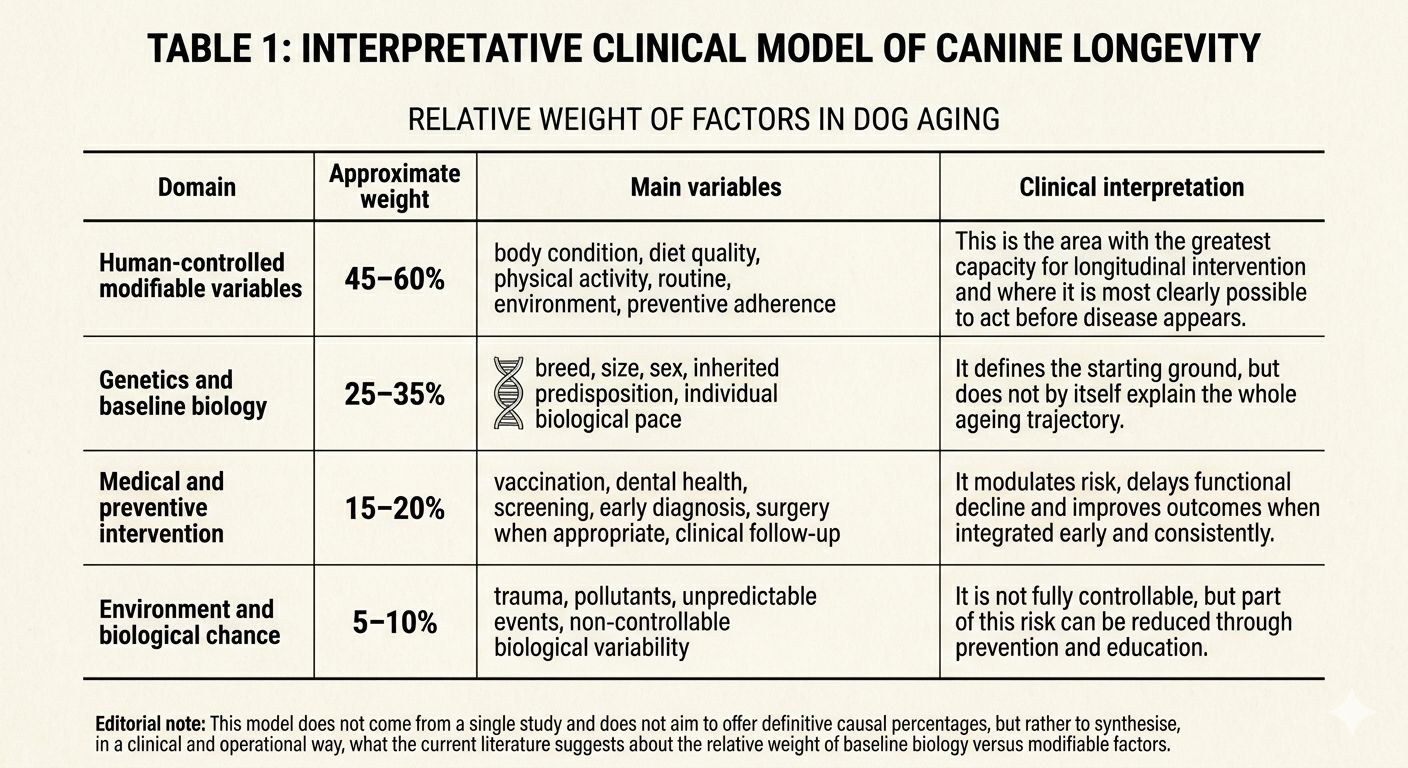
From data to shared responsibility
This is where the conversation stops being merely scientific and also becomes uncomfortable in terms of responsibility. If we accept that a very significant part of canine ageing depends on accumulated daily decisions, then we can no longer present longevity as though it were little more than a genetic inheritance with a small cosmetic margin around it. It becomes a shared construction, shaped by the owner, the clinic, the veterinary nurse or technician, the industry, and by how they understand feeding as part of a biological trajectory.
That is why concepts such as omega-3, prebiotics, probiotics, polyphenols, antioxidants or functional nutrition no longer belong only to product development or nutritional marketing, but to an increasingly legitimate conversation about functional ageing and canine longevity [5][6]. They form part of a more modern, more preventive and more serious view of the ageing dog.
And this is where my most provocative statement comes in. I am not saying that all dogs will live to 25 years tomorrow. That would not be serious. What I am saying is something more uncomfortable, and perhaps more important: that in the 21st century we should no longer keep treating ten or fourteen years as an unquestionable mental ceiling. Canine Longevity Beyond 25 Years and Beyond is not a promise. It is a legitimate scientific provocation. A horizon that forces us to revisit, with more ambition and less resignation, how much of canine ageing we continue to accept simply because we have never really dared to rethink it.
The question that opens this series
Perhaps, then, the deepest mistake has not been that we did not know how long a dog lives, but that we assumed too quickly that the answer was enough. Because the truly important question is not how long a dog of a given breed lives on average, but what we are doing, or failing to do, at each life stage to influence how that dog ages, with what degree of metabolic resilience it reaches maturity, and with what functional capacity it reaches old age.
The next question, therefore, should no longer be whether canine longevity can be rethought, but something more demanding and more useful: what does science actually tell us today about the major biological axes of canine ageing, and how do inflammation, oxidative stress, microbiota, immunity, metabolism and mitochondrial function fit into them?
References
Available upon request.