
David López — Petiqueta
In human food this already happened. Yuka reports more than 85 million users across fifteen countries and a database of four million products, and there are now shoppers who turn a package over in the aisle before deciding. Pet food lagged behind, but the gap is closing.
This article is not about one app. It is about what changes on your shelves, or in your brand portfolio, when the owner starts scoring in front of the display — and about what turns up when you measure an entire catalogue against that standard.
What changes is not the purchase. It is the moment of doubt
One difference matters before transferring the human-food precedent: here the consumer is not deciding for themselves. They are deciding for an animal that will not complain and has no opinion. That makes the decision more anxious and less elastic. Owners do not switch brands out of curiosity. They switch because somebody gave them a reason to distrust the one they had.
For the point of sale, the practical effect is that the conversation moves earlier. Doubt about composition used to surface at home while reading the bag, or in the veterinary consultation. It now surfaces in the aisle, product in hand, with a screen showing a number. Whoever serves the customer no longer gets the first word.
This is not automatically a threat. A specialist shop that can explain why a product scores what it scores gains ground against e-commerce, because it answers what the screen does not. The real threat is being caught not knowing what the label of your own range actually says.
What these algorithms actually look at
It is worth demystifying: no artificial intelligence decides anything. What exists is a set of fixed rules applied to what is printed on the packaging.
In our case, six criteria with declared weights: protein source (30 points), guaranteed analysis (20), filler and cereals (15), additives and preservatives (15), label transparency (10) and nutritional standard (10). The rules are published so that anyone can challenge them.
The central piece is the ingredient order. Regulation (EC) 767/2009 requires ingredients to be listed by decreasing weight, so the opening positions are what genuinely makes up the product. That is where an algorithm effortlessly spots three things a hurried shopper never did:
- The category term. “Cereals”, “vegetable by-products”, “oils and fats”, “meat and animal derivatives”. These are lawful, perfectly correct categories, but they do not say what is inside — and they allow the content to change without the label changing.
- The same cereal declared across several entries — maize, maize gluten, maize flour — divides the weight, and none of the three appears first.
- The missing percentage. “Chicken” with no figure is not the same as “dehydrated chicken 26 %”, and the difference between them is precisely what an algorithm can measure.
None of this judges raw-material quality. It judges what the manufacturer chose to disclose.
What an entire catalogue looks like when you measure it
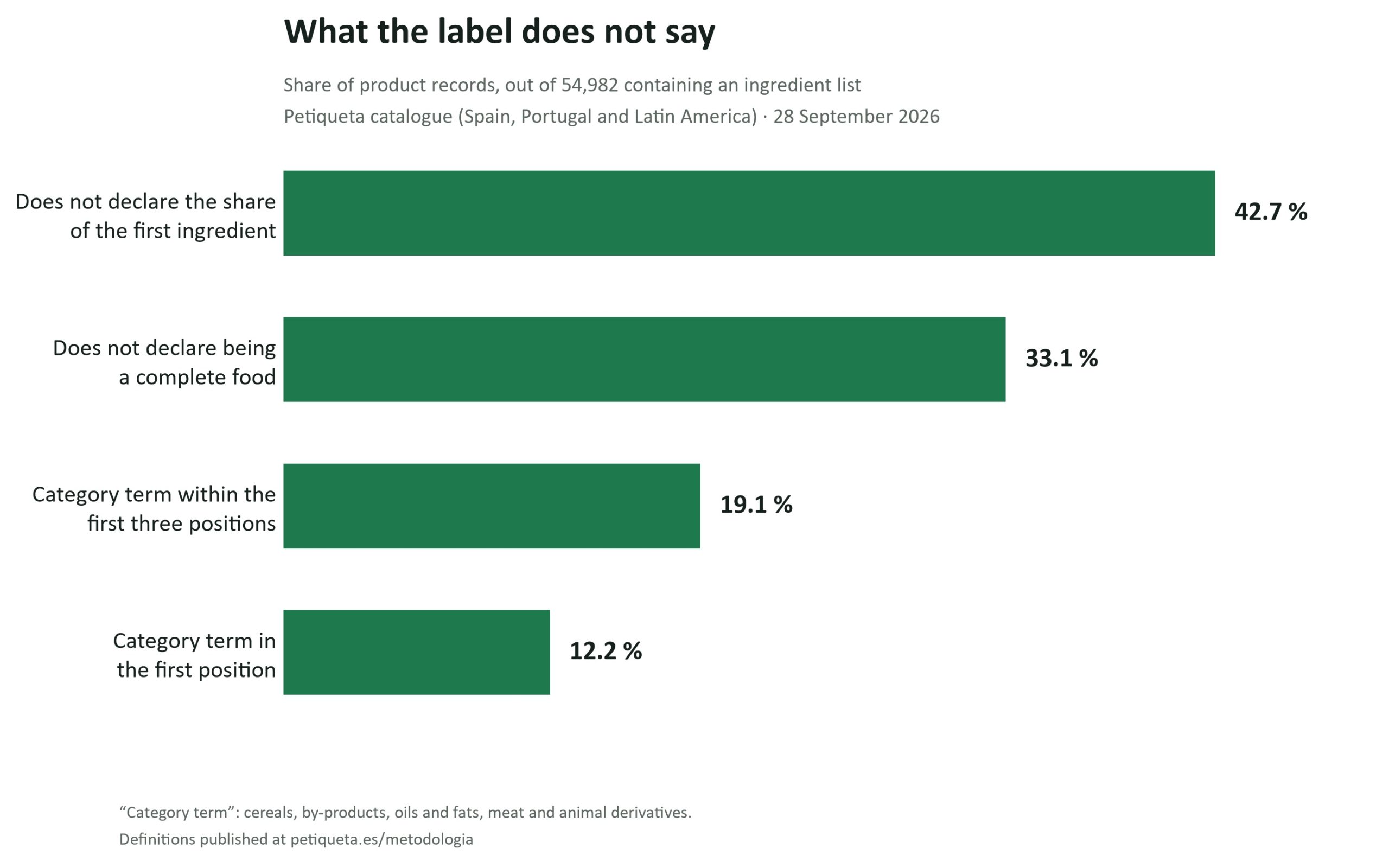
These are the figures we contribute to this article, published nowhere else. Sample: 54,982 product records containing an ingredient list, out of a catalogue of 56,814, measured on 28 September 2026. It covers dry, wet and treats for dogs and cats across the Spanish, Portuguese and Latin American markets.
| What was measured | Result |
| Category term within the first three positions | 19.1 % |
| Category term in the first position | 12.2 % |
| First ingredient: named meat or fish | 49.0 % |
| Does not declare the percentage of the first ingredient | 42.7 % |
| Does not declare being a complete food (FEDIAF/AAFCO) | 33.1 % |
Three readings for your business.
One in five references is opaque exactly where weight matters most. Not unlawful — opaque. That 19.1 % is what holds up worst against a screen, because the owner does not see a technical nuance. They see that they are not being told what they are buying.
Four in ten do not declare how much of their main ingredient they contain. This was the figure that surprised us most, because declaring it costs nothing to anyone with a good product. Those who withhold it compete at a disadvantage against those who do not — a disadvantage that only becomes visible when someone places them side by side.
A third do not state whether the food is complete. For a veterinary practice this matters more than any score: a complementary food used as sole nutrition is a clinical problem, not a marketing one.
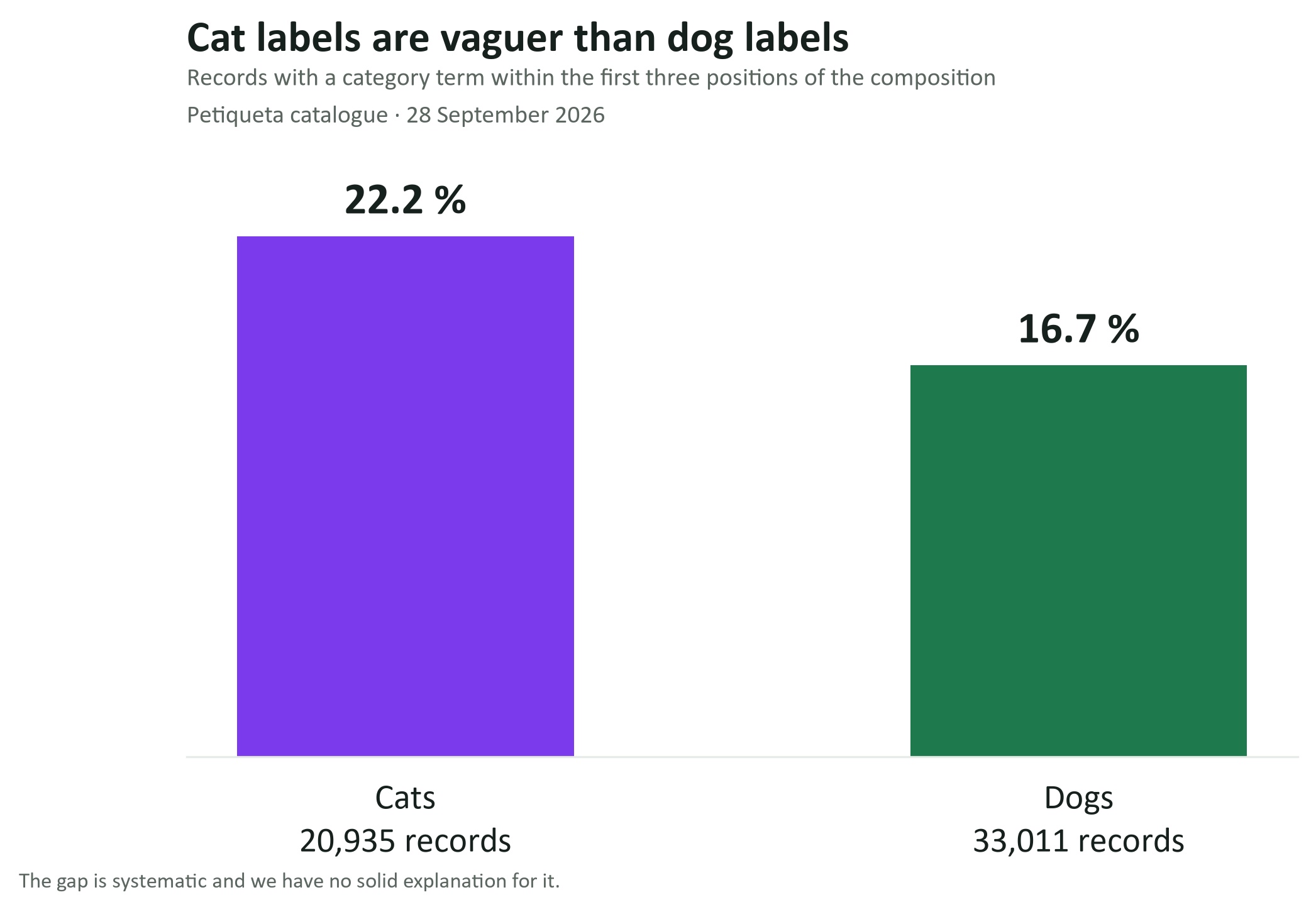
And a finding we did not expect: cat labels are systematically vaguer than dog labels — 22.2 % of category terms in the opening positions versus 16.7 % for dogs, across 20,935 and 33,011 records respectively. We have no solid explanation for that gap, and we would be interested to read one from somebody who formulates.
What a brand or a retailer can actually do
What raises a score is exactly what makes a product more honest, and that is fortunate: there is nothing to optimise for the algorithm. There is only a better way to state what you already do.
- Declare the percentage of the main ingredient. Highest impact, lowest cost. If the product is good, the number makes the case by itself.
- Make categories specific. “Chicken fat” instead of “oils and fats”. If the source varies by batch, saying so is also an answer.
- Declare the standard. Complete or complementary, and against which guideline. A third of the market is staying silent on this.
- For retail: get there first. Know how your range scores before a customer tells you. A shop that can explain why a product scoring 60 is right for a particular dog sells better than one that can only dispute the number.
The limits, stated by us
It would be dishonest to close without this.
A score reads the label, not the product. It does not measure digestibility, actual raw-material quality, supplier control, or whether a plant does what it claims. A scrupulous manufacturer with a terse label scores worse than a mediocre one with a talkative label — that is a limitation of method, not an opinion about anyone.
Nor does it replace the veterinarian, and no score should outweigh a prescription.
Our position is that figures should be published alongside their definition so they can be argued with. If someone who formulates believes one of these numbers is badly measured, we are more interested in that conversation than in the number itself.
Petiqueta is an independent project developed in Spain. No brand pays for its score or can alter it. The project is funded by voluntary user subscriptions and by clearly labelled retailer affiliate links, which play no part in calculating the score. The full methodology is public at petiqueta.es/metodologia.
Sources
- Yuka figures (users, countries, database size): data published by the company — yuka.io
- Ingredients listed by decreasing weight: Regulation (EC) No 767/2009 on the placing on the market and use of feed
- Nutritional adequacy standards: FEDIAF Nutritional Guidelines and AAFCO Nutrient Profiles
- Catalogue figures: own measurement across 54,982 records containing an ingredient list, 28 September 2026. Methodology and definitions at petiqueta.es/metodologia