


Technical review series This article forms part of a three-part technical review series on canine longevity, beginning with nutrition, body condition and digestive health, before moving into ageing biology and its practical application.

Ignasi (Nacho) Navarro-Regnè. Veterinarian, PMD from IESE and Master’s in AI, specialized in canine longevity and nutrition, with extensive business development experience in APAC.
Why functional nutrition must stop being understood as a sum of ingredients and start being seen as a tool to modulate ageing
In the first article of this series, we questioned an idea that has been too easily accepted: that canine longevity is almost a fixed number, defined mainly by breed, size and genetics. But a table describes populations; it does not explain how an individual dog ages, nor how much of that trajectory is built every day through nutrition, weight, prevention, environment and owner adherence.
From life expectancy to real biology
The next question, therefore, must be more technical. If canine longevity cannot be understood only as a statistical average, which biological systems are actually shaping the way a dog ages? And, above all, what role does nutrition play within those systems?
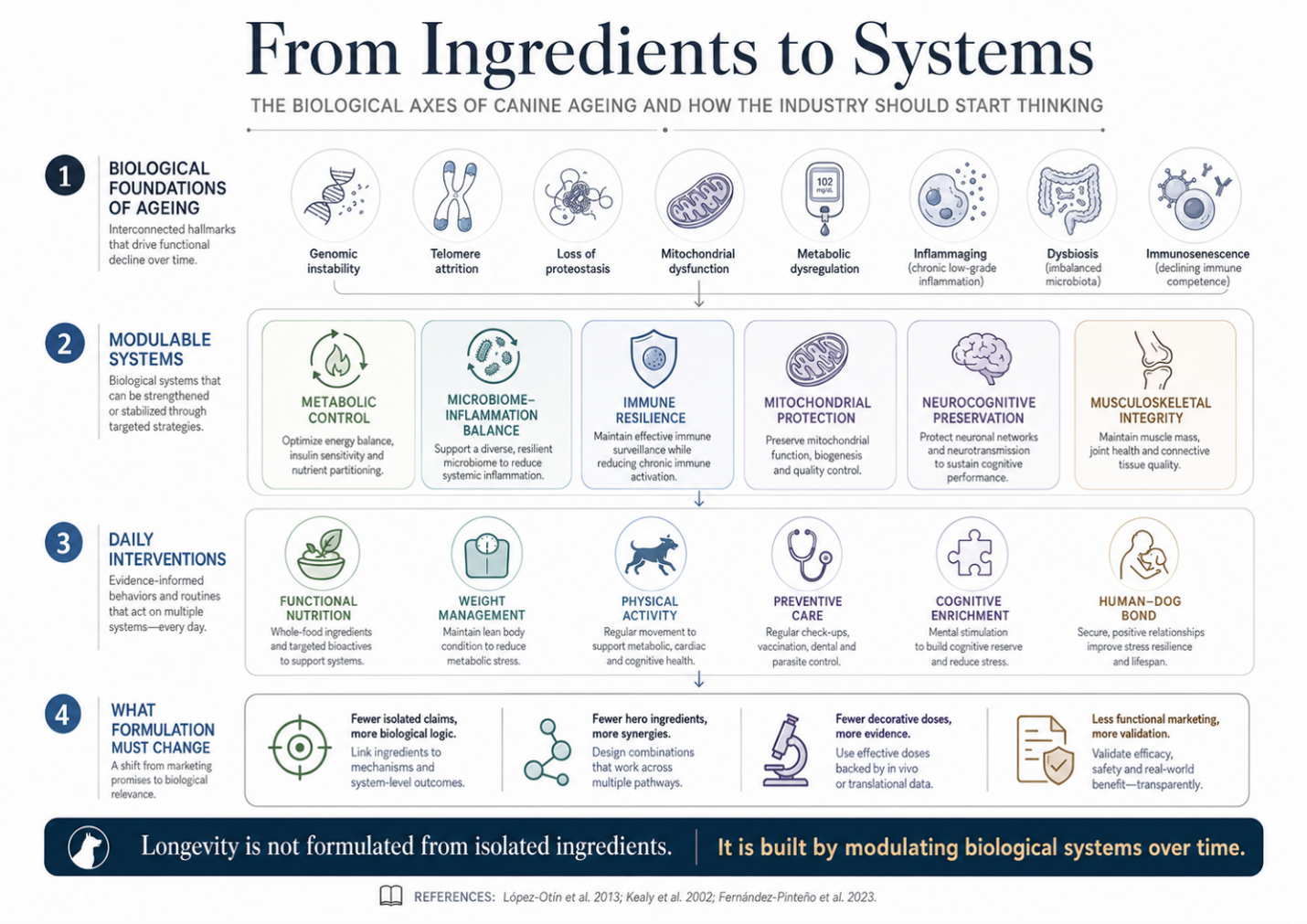
This question forces us to raise the level of the conversation. It is no longer enough to speak about functional ingredients, superfoods or attractive claims. If we want to discuss longevity seriously, we need to start thinking about metabolism, inflammation, microbiota, immunity, mitochondria, cognitive function and musculoskeletal health as an integrated network of modulable processes.
“Longevity is not built from isolated ingredients, but from biological signals repeated over years.”
The problem is not functional ingredients, but the way we interpret them. An omega-3, a prebiotic, a probiotic, a polyphenol, an antioxidant, a high-quality protein source or a joint-support compound may all make sense within a nutritional strategy. But their real value does not lie in appearing on a list; it lies in which biological system they help to support, through which mechanism, at what dose, with what bioavailability, in which food matrix and for how long.
Ageing as a network of processes
Geroscience has been showing for years that ageing is not simply the accumulation of time, but the progression of interconnected processes. These include genomic instability, telomere attrition, epigenetic alterations, loss of proteostasis, deregulated nutrient sensing, mitochondrial dysfunction, cellular senescence and altered intercellular communication [1].
In dogs, we still do not have a complete translation of all these mechanisms into daily clinical or nutritional practice, but the framework is useful because it allows us to stop speaking about age as a category and start speaking about ageing as a trajectory.
And that trajectory is not separate from nutrition. Every meal is, in reality, a metabolic, inflammatory, digestive and immunological signal. Diet does not only provide calories or essential nutrients; it also influences body composition, microbiota, metabolite production, oxidative load, immune response, intestinal barrier health and the organism’s ability to maintain homeostasis.
Metabolic control: the first axis of longevity
The first system we need to consider is metabolic control. It is probably the least spectacular from a commercial perspective, but one of the most important from a biological one. Body condition is not an aesthetic issue. It is a functional marker of the relationship between energy intake, lean mass, metabolic sensitivity, joint load, inflammation and disease risk.
The longitudinal study by Kealy and colleagues, published in 2002, remains a key reference precisely because it showed that maintaining a leaner body condition in dogs had an impact not only on weight, but also on life expectancy and the onset of age-related disease [2].
“Body condition is not aesthetic: it is a functional marker of the ageing we are building.”
This lesson has still not been fully absorbed. Before looking for the most sophisticated longevity molecule, we should ask whether we are formulating, recommending and educating in a way that helps dogs remain metabolically stable throughout life. This includes appropriate nutrient density, digestibility, protein quality, energy control, functional fibre, maintenance of lean mass and palatability that does not drive excess intake. In this sense, longevity nutrition begins long before the senior stage.
Microbiome and inflammation: the gut as an interface of ageing
The second system is the microbiome-inflammation axis. If we had to choose one frontier that is especially relevant for connecting nutrition and ageing, it would probably be this one. The gut is not a peripheral organ in the longevity conversation. It is an interface between diet, immunity, metabolism, inflammation and behaviour.
The microbiota participates in substrate fermentation, the production of metabolites such as short-chain fatty acids, immune modulation, intestinal barrier integrity and communication with other systems in the body [3][6]. For that reason, a diet oriented towards longevity cannot be limited to being complete and balanced in the classical sense; it must also consider what type of intestinal ecosystem it is helping to support.
“The gut is not a peripheral actor: it is an interface between nutrition, immunity, inflammation and metabolism.”
However, we need to be cautious. The microbiome does not explain everything, and not every fibre, prebiotic, probiotic or postbiotic turns a formula into a longevity tool. What matters is the logic of the whole. A highly digestible protein may reduce undesirable fermentative residues. Certain fibres may support beneficial metabolites. Some polyphenols may interact with the microbiota and participate in the modulation of inflammatory pathways. All of this matters because intestinal ageing is not only digestion; it is immunity, inflammation and systemic resilience.
Immune resilience: responding without becoming trapped in chronic inflammation
The third system is immune resilience. Ageing does not only mean accumulating damage, but losing proportional response capacity. With age, the immune system may become less efficient against real threats while, at the same time, maintaining a low-grade inflammatory activation that contributes to functional decline. This combination of immunosenescence and age-associated chronic low-grade inflammation, known as inflammaging, helps explain why nutrition, microbiota and prevention cannot be analysed separately [1].
From a nutritional perspective, this means thinking about adequate proteins and amino acids, essential fatty acids, vitamins, trace minerals, antioxidants, intestinal health and control of excess body fat, because all these elements influence inflammatory tone and immune function. It also means recognising that the immune system does not live in isolation: it responds to stress, sleep, activity, oral health, digestive status and body composition.
Mitochondria: energy, oxidative stress and function
The fourth system is mitochondrial protection. The mitochondrion sits at the centre of cellular bioenergetics, free radical production, muscle function, brain health and the capacity to adapt to exercise. In ageing dogs, speaking about vitality should not simply be an emotional word on the pack, but a conversation about energy efficiency, oxidative stress and functional maintenance.
Some nutrients and bioactive compounds, such as omega-3 fatty acids, certain antioxidants, mitochondrial cofactors or polyphenols, may be interesting within this framework, but the right question is not whether they are “good”. The right question is whether they are formulated with a clear biological hypothesis, a reasonable dose and an outcome that can be observed or measured [4].
Cognition and bond: the dog does not age in isolation
The fifth system is neurocognitive preservation. This dimension will become increasingly important in the conversation about canine healthspan, because a dog does not age well simply because it maintains acceptable laboratory parameters. It ages well if it preserves interaction, learning, emotional stability, orientation, rest, bond and adaptive capacity.
Nutrition participates here through cerebral energy support, fatty acids such as DHA, certain antioxidants, the gut-brain axis, inflammatory modulation and metabolic stability. But cognition does not depend only on diet. It also depends on environmental enrichment, physical activity, sleep, stress and the quality of the bond with the owner.
This is where a fundamental idea appears: canine longevity is not only a nutritional intervention, but a shared biology. The dog ages inside a home, inside a human routine, within a certain level of activity, stress, preventive care and adherence. In that sense, the Human-Dog Synchronisation Loop is not a pleasant metaphor, but a way of remembering that the dog’s ageing is deeply influenced by the human ecosystem in which it lives.
Mobility: beyond the joint
The sixth system is musculoskeletal integrity. Traditionally, we have approached this axis from the joint, but functional longevity requires a broader view. Healthy mobility depends on cartilage, bone, muscle, connective tissue, inflammatory control, body weight, adapted exercise and preservation of lean mass.
A formula oriented towards mobility or healthy ageing should not be limited to including a well-known joint ingredient, but should also consider quality protein, amino acids, anti-inflammatory fatty acids, appropriate minerals, energy control and strategies that help the dog keep moving. Because mobility is not a luxury in the senior dog; it is one of the pillars of functional independence.
From hero ingredients to modulable systems
When these six systems are read together, the conclusion is clear. Functional nutrition should not be formulated as a collection of hero ingredients, but as a strategy of biological modulation. Fewer isolated claims and more systems logic. Fewer decorative doses and more evidence. Fewer ingredients added to build a story and more formulation decisions oriented towards metabolism, microbiota, immunity, mitochondria, cognition and mobility.
“The future of longevity nutrition is not about adding more claims, but about formulating better biological hypotheses.”
And this brings us back to the idea of daily ritual. Longevity is not decided by a single intervention, but by small signals repeated thousands of times. An appropriate diet may contribute to metabolic control. Good digestibility may support intestinal stability. A fibre and microbiota strategy may influence metabolites and inflammation. Optimal body condition may reduce joint load and metabolic stress. Daily activity may preserve muscle and cognitive function. None of this seems spectacular in isolation, but together it forms the everyday biology of ageing.
The question that opens the next article
It would not be rigorous to present canine longevity as a closed equation, nor as a promise of more years for every dog. The point is that we already know enough to stop treating ageing as something that simply arrives.
There is a modulable margin; it begins before old age, and nutrition is part of it when it is formulated with scientific judgement.
The next question, and also the next article in this series, will be which ingredients, matrices, combinations, doses and biomarkers can help us build a longevity nutrition approach based on mechanisms, evidence and shared responsibility.
Because longevity is not promised: it is studied, formulated and built with rigour, day after day.
References
[1] López-Otín C, Blasco MA, Partridge L, Serrano M, Kroemer G. The hallmarks of aging. Cell. 2013;153(6):1194-1217. DOI: 10.1016/j.cell.2013.05.039.
[2] Kealy RD, Lawler DF, Ballam JM, et al. Effects of diet restriction on life span and age-related changes in dogs. J Am Vet Med Assoc. 2002;220(9):1315-1320.
[3] Fernández-Pinteño A, Pilla R, Manteca X, Suchodolski J, Torre C, Salas-Mani A. Age-associated changes in intestinal health biomarkers in dogs. Front Vet Sci. 2023;10:1213287. DOI: 10.3389/fvets.2023.1213287.
[4] You I, Kim MJ. Comparison of Gut Microbiota of 96 Healthy Dogs by Individual Traits: Breed, Age, and Body Condition Score. Animals. 2021;11(8):2432.
[5] Suchodolski JS, Dowd SE, Wilke V, Steiner JM, Jergens AE. 16S rRNA Gene Pyrosequencing Reveals Bacterial Dysbiosis in the Duodenum of Dogs with Idiopathic Inflammatory Bowel Disease. PLOS One. 2012;7(6):e39333.
[6] Koh A, De Vadder F, Kovatcheva-Datchary P, Bäckhed F. From Dietary Fiber to Host Physiology: Short-Chain Fatty Acids as Key Bacterial Metabolites. Cell. 2016;165(6):1332-1345.