

By Jason Pierce
President, StellarNet, Inc.
As pet food manufacturers expand ingredient portfolios and diversify their supplier networks, ensuring consistent raw material quality has become increasingly challenging. While Certificates of Analysis (COAs) and traditional laboratory methods remain essential, many quality programs are incorporating rapid spectroscopic screening to better understand ingredient variability before production begins.
Premium pet food formulations often include proteins, grains, oils, vitamins, botanicals, probiotics and specialty ingredients sourced from multiple suppliers and geographic regions. Even when incoming materials meet established specifications, natural variation in growing conditions, processing methods, moisture content and particle size can influence manufacturing performance.
For quality teams, the challenge is no longer simply confirming that an ingredient is what the supplier claims. Increasingly, the objective is understanding how consistently that ingredient performs from shipment to shipment.
Near-infrared (NIR) spectroscopy has become one of several analytical tools supporting that objective. Used alongside established laboratory methods, it provides rapid, non-destructive information that can help identify unusual ingredient variability before materials move into production.
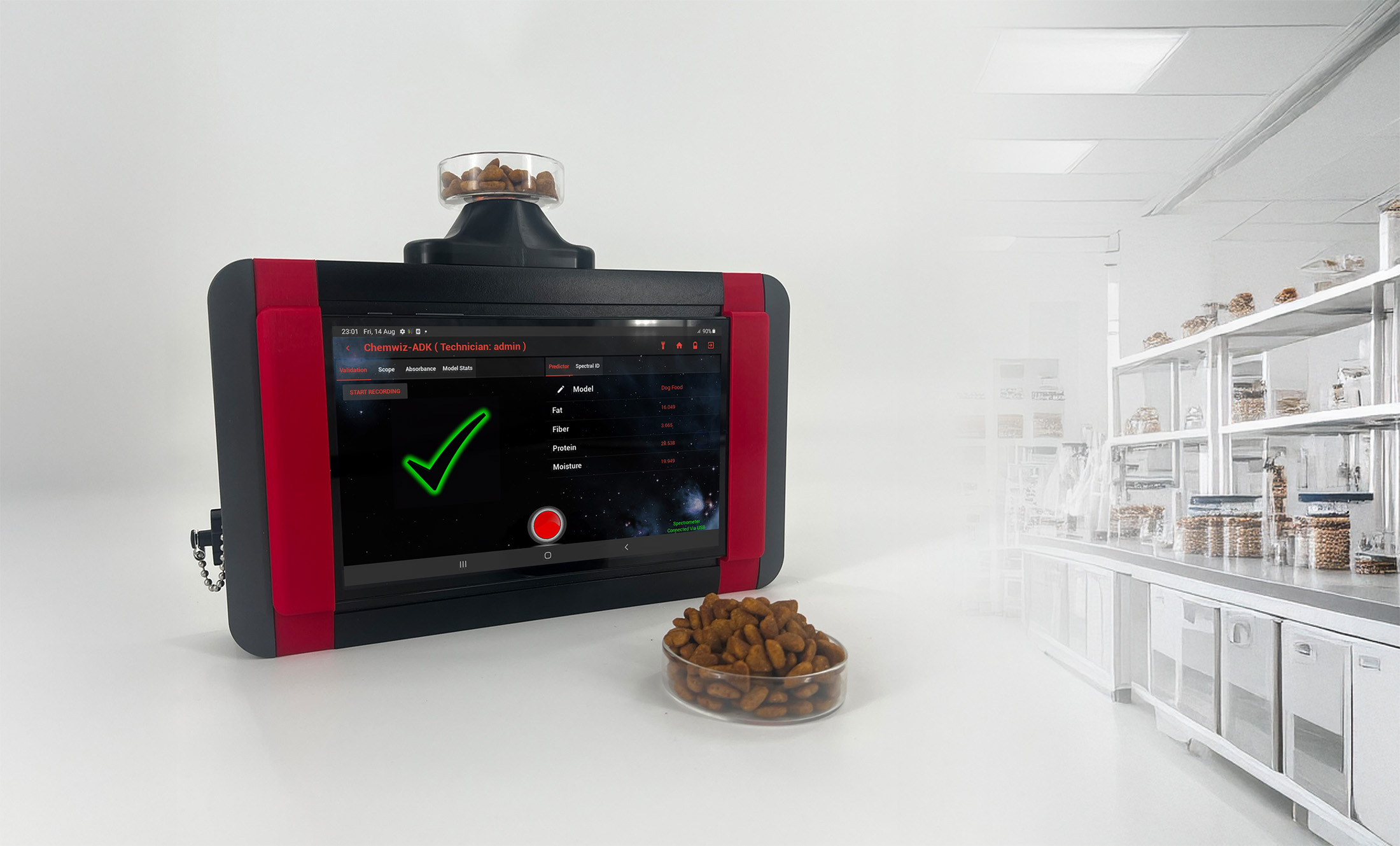
Photo Credit : Stephanie Boxel, StellarNet Inc.
Why Ingredient Variability Matters
Small differences in raw materials can influence manufacturing in significant ways. Changes in moisture, particle size, protein composition or processing methods may affect:
- Extrusion performance
- Product texture
- Moisture consistency
- Batch-to-batch uniformity
- Finished product appearance
- Production efficiency
Many of these differences are difficult to detect through visual inspection alone. Spectroscopic measurements provide an additional layer of information by evaluating the overall spectral fingerprint of a material rather than relying solely on appearance or documentation.
Looking Beyond Identity Testing
Incoming inspection has traditionally focused on confirming ingredient identity and verifying supplier documentation.
Rapid spectroscopic screening allows quality teams to ask additional questions:
- Does this shipment resemble previous approved lots?
- Is one supplier demonstrating greater variability than another?
- Are seasonal changes beginning to appear?
- Does this shipment warrant additional laboratory evaluation before release?
The answers do not replace established analytical methods. Instead, they can help quality professionals determine where additional investigation may provide the greatest value.
What Published Research Shows
Near-infrared (NIR) spectroscopy has been used in food and agricultural analysis for more than half a century. Today, researchers are extending those same analytical principles beyond routine composition analysis to include ingredient authentication, supplier verification and chemometric classification.
One study published in the Journal of Near Infrared Spectroscopy investigated whether NIR spectroscopy could distinguish authentic fish meal from fish meal intentionally adulterated with meat-and-bone meal. The researchers reported that their Partial Least Squares (PLS) classification model correctly identified nearly all adulterated validation samples while also demonstrating that representative calibration samples had a greater influence on model performance than many of the mathematical preprocessing techniques evaluated.
That conclusion remains applicable to modern ingredient verification programs.
A calibration library that reflects normal supplier and ingredient variation is often more valuable than increasingly complex algorithms developed from limited datasets.
Additional published studies examining feed ingredients have reached similar conclusions. Researchers have shown that visible and near-infrared spectroscopy, when combined with appropriate chemometric methods and representative reference data, can rapidly classify ingredient samples, detect unexpected variation and support ingredient authentication programs.
Although these investigations focused primarily on feed ingredients rather than finished pet food products, the underlying analytical challenge is the same: recognizing unexpected ingredient variability before it affects manufacturing.
Building Better Supplier Intelligence
One of the advantages of spectroscopic screening is its ability to create historical reference libraries.
Rather than comparing every shipment with a single reference spectrum, manufacturers can build libraries using measurements collected from numerous approved lots over time.
Those libraries allow quality teams to monitor:
- Long-term supplier consistency
- Seasonal variation
- Lot-to-lot differences
- Process changes
- Emerging trends that may warrant additional laboratory testing
Rather than replacing laboratory analysis, spectroscopy helps quality teams determine where laboratory resources can provide the greatest value while building a deeper understanding of supplier performance.
Engineering Perspective
“When measurements are collected consistently over time, spectroscopy becomes more than an identification tool—it becomes an engineering tool for understanding supplier performance.
Historical data help quality teams recognize trends and investigate variability before it reaches production.”
— Muhammad S. Khan
Vice President & Director of Engineering, StellarNet, Inc.
Supporting Better Quality Decisions
Most quality professionals recognize that no single analytical technique answers every question.
Spectroscopy is most effective when incorporated into a broader quality program that includes supplier qualification, laboratory confirmation, process monitoring and statistical quality control.
Its strength lies in providing rapid information that helps manufacturers make better-informed decisions during receiving inspection while preserving laboratory resources for materials that require additional evaluation.
As ingredient portfolios continue to expand and supply chains become increasingly diverse, the ability to rapidly recognize unusual variation is becoming more valuable across pet food manufacturing.
Final Thoughts
Ingredient verification will continue to rely on established laboratory methods, supplier qualification programs and sound quality systems.
Rapid spectroscopic screening complements those efforts by providing additional information early in the receiving process, allowing quality professionals to better understand supplier consistency, prioritize confirmatory testing and monitor long-term ingredient variability.
As pet food formulations and global sourcing continue to evolve, combining rapid screening with traditional analytical methods offers manufacturers another tool for strengthening quality throughout the production process.
Selected References
- Murray, , Aucott, L. S., & Pike, I. H. Use of Near Infrared Reflectance Spectroscopy to Detect Adulteration of Fishmeal with Meat and Bone Meal. Journal of Near Infrared Spectroscopy. This study demonstrated that NIR spectroscopy combined with PLS classification could distinguish authentic fish meal from adulterated samples and highlighted the importance of representative calibration datasets.
- Cozzolino, D., Murray, I., Scaife, J. R., & Paterson, R. Visible and Near Infrared Reflectance Spectroscopy for the Detection and Authentication of Animal Feed Animal Feed Science and Technology. This work demonstrated the value of VIS/NIR spectroscopy and chemometric analysis for rapid ingredient classification and authentication.
About the Author
Jason Pierce is President of StellarNet, Inc., where he works with researchers and manufacturers on spectroscopy applications for quality assurance, industrial process measurement and analytical instrumentation.
Additional educational resources on spectroscopy applications for ingredient verification are available through the StellarNet Industrial Analyzers Learning Center: